Menu

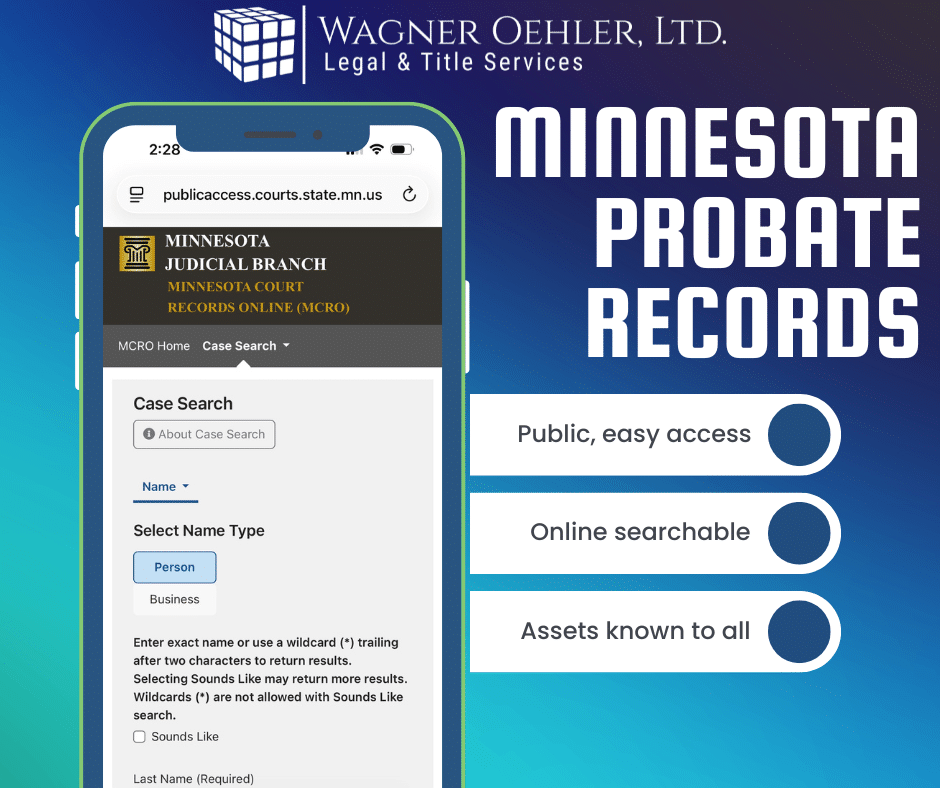 Your Probate Records Are Public in Minnesota — And They’re Online
Yes, probate records in Minnesota are public and available online. If your estate goes through probate, details about your assets, heirs, and distributions can be accessed by anyone. Proper estate planning—especially using trusts—can help Minnesota families avoid probate and keep their affairs private.
Many people are surprised to learn that probate records in Minnesota are public information. Even more concerning, much of that information is now accessible online.
If you pass away and your estate requires probate, your family’s personal and financial details may be visible to anyone who searches court records. That reality is one of the most overlooked reasons people choose to plan ahead—and one of the strongest arguments for avoiding probate when possible.
When an estate is probated in Minnesota, the court file often includes:
These records are not private. In many cases, they can be accessed online without special permission.
Most families assume estate matters remain private. Probate changes that.
Public probate records can expose:
For farm families, landowners, and business owners, this lack of privacy can create unnecessary risk, unwanted attention, and avoidable stress for surviving family members.
Yes. Minnesota court records are accessible through the state’s public access systems. Anyone can search by name to see whether a probate case exists and review available filings.
Once documents are filed with the court, they generally become part of the public record.
One of the primary benefits of a properly structured trust is probate avoidance.
Assets held in a trust typically:
A will, on the other hand, must be submitted to probate court, making it public by default.
This is why many Minnesota families choose trust-based estate planning—not just for efficiency, but for privacy.
Farm estates are often more complex than other estates. They may include:
When those details become public through probate, it can disrupt operations, invite disputes, and expose sensitive financial information at exactly the wrong time.
Avoiding probate helps preserve continuity, privacy, and control.
Yes. Probate records in Minnesota are public court records and may be accessed by members of the public, often online.
Yes. Once a will is filed with the probate court, it generally becomes part of the public record.
In most cases, yes. Assets properly held in a trust usually avoid probate and are not part of the public court record.
Yes. With proper estate planning—such as trusts, beneficiary designations, and proper asset titling—many estates can avoid probate entirely.
Public probate records can expose personal, financial, and family information. Many people prefer to keep these matters private and out of the court system.
To learn more about estate planning, keep an eye on our Events page located at: https://www.wagnerlegalmn.com/events/
If you’re ready to start being proactive about your estate plan and make sure your home transfers in the manner you intend, contact us to get started.
Want to stay informed? Subscribe to our quarterly newsletter for updates.
© 2026 Wagner Oehler, Ltd
Legal Disclaimer | Privacy Policy
Law Firm Website Design by The Modern Firm
 Share
Share